
TALES FROM THE FORGE:
THE WOLF’S BRAND
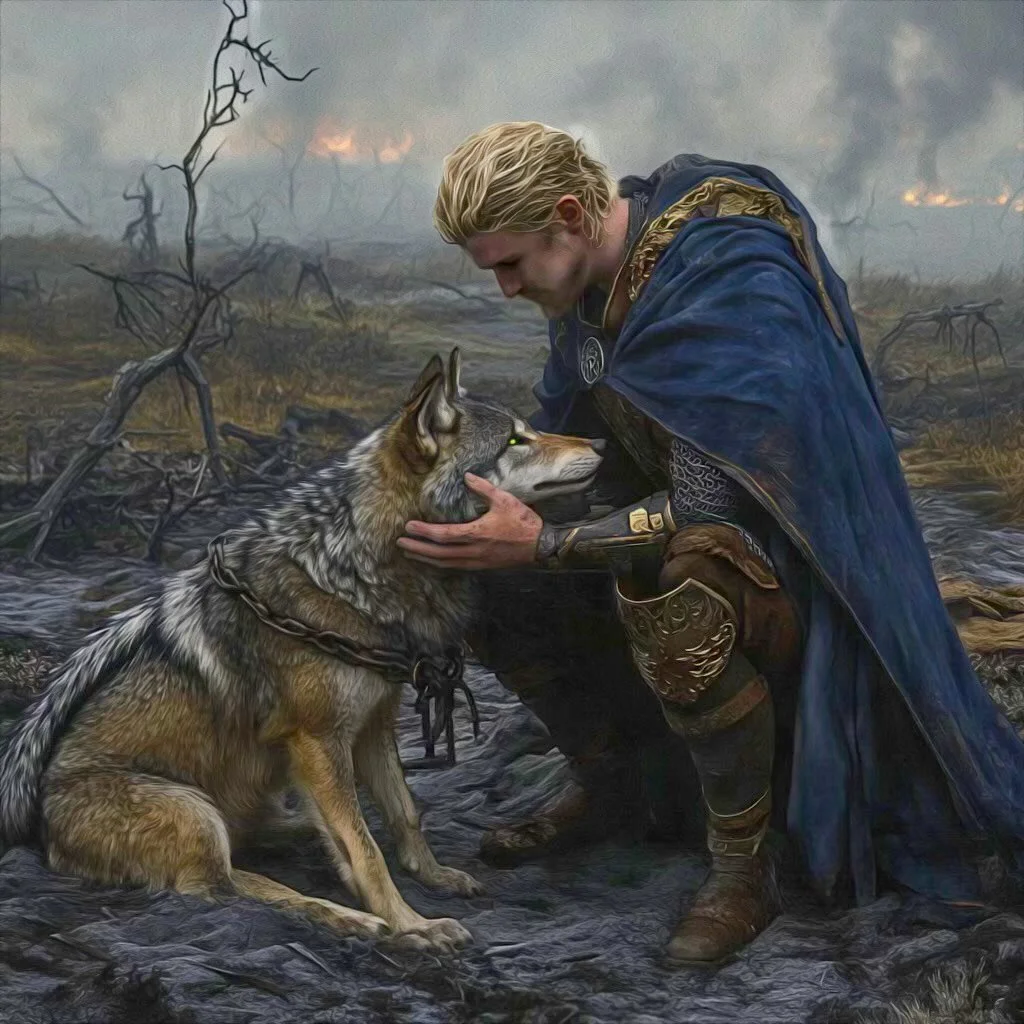
In the shadow of Castle Ashspire, where the gray plains breathe cinder and the air tastes of smoke and ash, fate set upon my path a wounded wolf during one hot summer’s day.
With the sun beating down on our hunting party as we neared the castle walls, my men were eager to return to the comforts and simple pleasures of the castle accommodations. As we rode along the Cinderwalk Road, I glimpsed an animal slumped beneath a blackened thornbush.
She lay upon the darkened earth, her leg torn open, sinew exposed, and bleeding into the ash, her fur matted with soot and her eyes wild with pain. Among the soot-covered fur, along her left flank, the fur had been burned away, leaving exposed, scarred flesh. I could tell the burn was old—far older than the trap which now ensnared her. Whatever had scarred her had done so long before I found her beneath the thornbush that day.
She stayed crouched near the bush, her latest kill still clutched tightly in her jaws, her ivory teeth glistening in the sunlight dripping with the crimson of the small animal’s lifeblood.
I dismounted, and though my kingsguards warned me to stay on my horse and continue on, something in the wildness and grace of the beast would not allow me to ride past.
I approached the she-wolf cautiously, her emerald eyes staring warily at me, her gaze hard and defiant despite the ribs that showed beneath her soot-matted fur. The wolf snarled and snapped as I slowly approached, but, sensing my intentions, she didn’t lash out.
Then, with my own hands, I broke the snare that bound her and released her from its jagged grasp.
Although not broken, her leg was badly injured, and after trying to gather her feet underneath her, she was unable to stand on her own.
The bone would mend I knew. Whether the rest of her would, I was not certain.
I saw it in the way her eyes refused to meet mine.
The wolf let out a low growl as I removed my glove and slowly placed my hand on her brow, petting the hair between her stiffened ears. Running my hands tenderly across her head and back, she seemed to relax under my touch.
Removing my light blue cloak, I gathered her up in my arms, her fur leaving a mess of soot-darkened wool, and carried her back to my quarters beneath the black spire.
For seven nights, I fed her by my own plate and kept her close to the warmth of my hearth. Fire purifies I knew, and I believed that under my roof, beneath my protection, under my caring, watchful eye, whatever had broken her would mend in time.
And after some time, the wolf rose and walked again—limping but still proud. Proud as the day I found her—too proud to beg and too stubborn to yield. Though I cared for her as best as I could, her wounds and scars I tended to never fully healed. They left patches of missing fur and scars I knew she could never hide.
During the dreary nights of that ash-choked summer near Ashspire when the wind howled through the ashfields, she would howl with it, and I smiled, thinking her spirit restored. Even wounded, she refused to sleep until sleep settled over me.
She followed me thereafter—through the charred valleys and along the lonely roads and the molten ridges where few dared to tread—running our quarry ahead of us and lying silent at my feet when the day’s duties were done.
In the solitude of the wasteland, king and animal shared a strange peace: two creatures forged by fire, bound by scars.
But peace, like flame, does not last without cost.
Along the road one day as I and my kingsguards shared a warm meal from the day’s hunt by the light of the campfire, the wolf no longer sat by my side as she did the weeks prior. Although offering her a portion of my meal, she no longer accepted the provisions of my camp. On more than one occasion, she would go off alone into the wood to hunt down her own meal for the evening and return later with the blood of her latest kill still marking her muzzle.
And when the blood moon rose above Ashspire—red as a wound, bright as betrayal—something ancient seemed to stir in the wolf’s heart.
I could see it in her eyes.
Something had changed.
In the stillness before dawn, as I saddled my horse and gathered up my belongings and gear, I called for the wolf to join me at the front of the march. From behind me at the edge of the camp, she was looking intently at the horizon, her ears stiff as if listening for something in the distance. She waited there for a long while.
As I tightened my sword belt, I heard her soft steps behind me and felt a rush of relief at her return—until the snarl split the morning air and her fangs flashed in the light of the sunrise.
She lashed out, and with fangs and claws, she tore at my tunic and her jaws closed around my hand with a crack of teeth against bone. Blood ran down my hand and my arm and spilled to the ashen ground. I tried to grab hold of her, but she vanished into the wood before she could strike again.
When it was over, only the sound of the wind remained—sighing through the ashes like a dying breath.
No man among us spoke.
I did not curse her as she departed.
But neither did I call her name again.
I gathered up some linen bandages to stop the bleeding, and one of my kingsguards set to boiling wine to apply to the wound.
The wound being dressed and tended to, our party set off to our next visit with a nearby high lord.
Upon returning to Castle Ashspire, when my healer came to tend my hand, I refused his healing salves and refused the needle and thread to sew up the deep punctures and lacerations in my arm.
The wounds throbbed with every pulse of my heart, yet I would not have them mended.
When asked why, I gazed into the fire of my hearth and said, “A smith remembers every burn. The wound teaches the hand where not to reach again.”
The scar I bore thereafter came to be known as the wolf’s brand.
And though the fires of Ashspire have long since dimmed, those who bear the mark of loss still speak the words I said that night:
“Mercy can save a soul, but it cannot change what the fire forged of it.”
I was forged in the fire.